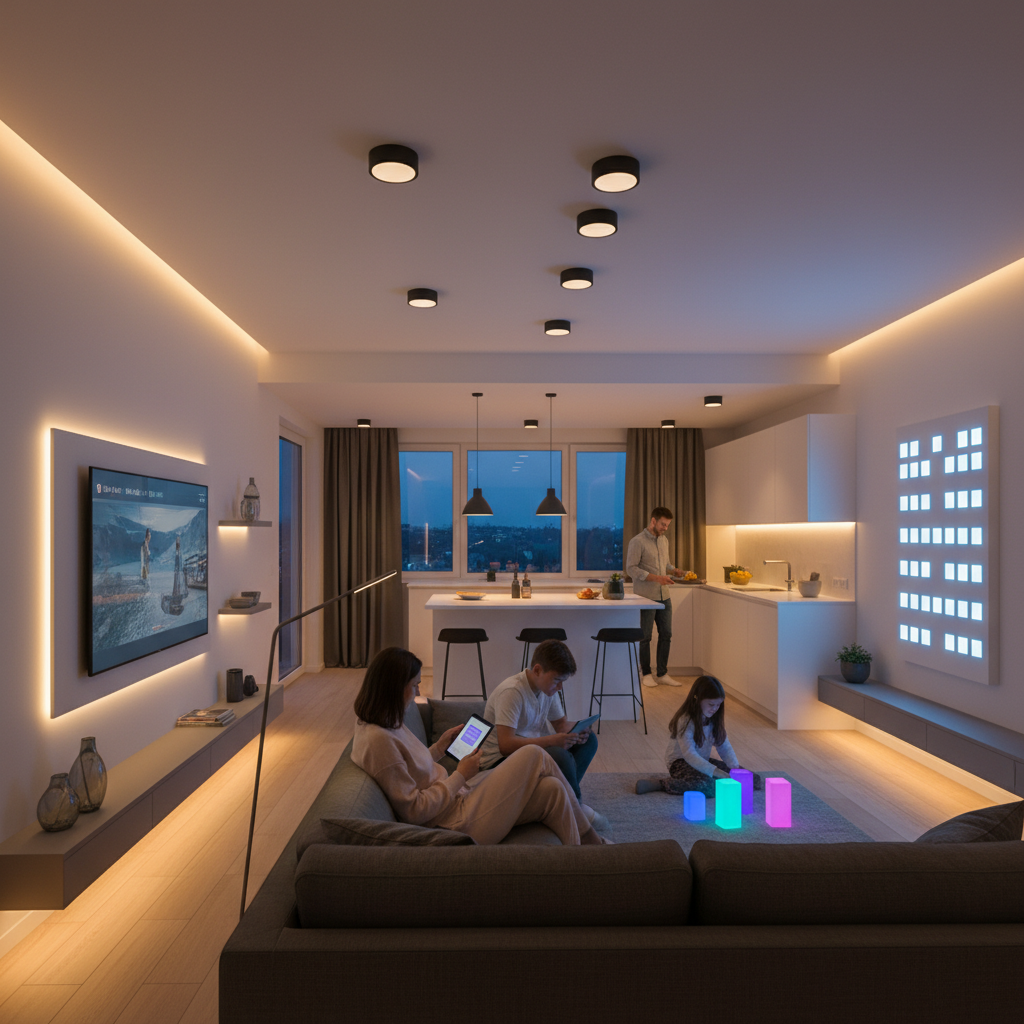
Picture this: It’s a Tuesday evening in February 2026. You’re walking into your living room after a long day. As you step inside, the lights gently brighten to a warm, inviting glow. The system knows it’s the end of the day, so it automatically adjusts the color temperature to promote relaxation. No switches, no voice commands – just a seamless transition into a comfortable space. That’s the promise of smart lighting in 2026: intuitive, adaptable, and designed to enhance your life.
## Why Smart Lighting? Beyond the On/Off Switch
The evolution of smart lighting goes far beyond the basic functionality of turning lights on and off with your phone. It’s about creating personalized environments that respond to your needs, improve your well-being, and even save you money. Modern smart lighting uses energy-efficient bulbs, motion sensors, and AI to learn your preferences and adjust brightness and color temperature accordingly.
### Real-Life Scenario: The Smart Home Upgrade
Let’s say you’re like me. I started my smart home journey a few years ago, mainly because I was tired of wasting energy. I was also intrigued by the idea of a home that could anticipate my needs. So, I started small, replacing a few standard bulbs with smart LEDs.
I quickly realized the potential. With a few taps on my phone, I could adjust the brightness, change the color, and set schedules. It was convenient, but I soon craved more. I wanted my home to *think*.
## Misconceptions and Misuses: Avoiding the Pitfalls
Many people still misunderstand the true potential of smart lighting. Here’s a breakdown of common misconceptions:
* **It’s all about automation:** While automation is a part of it, the real power lies in adaptability. Smart homes in 2026 are designed to learn your habits and adjust accordingly.
* **It’s too complicated:** While early smart home systems were complex, today’s systems are designed to be user-friendly, with intuitive apps and voice control.
* **It’s a luxury:** Smart lighting can actually *save* you money on your energy bills.
The biggest misuse of smart lighting is probably *over-complicating* things. Sure, you *can* create a hundred different scenes, but do you really *need* to? Start simple, and gradually add features as you become more comfortable.
## Common Long-Term Problems and How to Avoid Them
Even with the best technology, problems can arise. Here’s how to troubleshoot:
* **Connectivity issues:** Smart lights rely on a stable Wi-Fi network. Ensure your router is up-to-date, and consider a mesh network if you have a large home.
* **Firmware updates:** Keep your smart lighting system updated to benefit from new features and security patches.
* **Incompatibility:** Choose a system that’s compatible with other smart home devices, and consider a hub for unified control.
* **Delayed responses or missed commands:** This can be a sign of network problems or outdated software. Check your internet connection and update your devices’ firmware.
## Smart Usage and Maintenance Habits for 2026
* **Start with the essentials:** Focus on the rooms where lighting makes the biggest impact, like living rooms and kitchens.
* **Use schedules and automation:** Set up schedules to automatically turn lights on and off, or dim them during certain times of the day.
* **Monitor energy usage:** Many smart lighting apps provide insights into your energy consumption, helping you to make smarter choices.
* **Regularly check and update:** Perform regular checks to ensure all devices are up-to-date and functioning correctly.
* **Integrate with other smart home devices:** Link your lights to your security system, thermostat, or entertainment system to create a more cohesive smart home experience.
### Upgrading Your Lighting System
To get the most out of your smart lighting, consider these upgrades:
* **AI-powered lighting:** These systems learn your preferences and adjust brightness and color temperature accordingly.
* **Voice control:** Use voice commands via Alexa or Google Assistant for hands-free convenience.
* **Circadian rhythm lighting:** Mimic natural daylight patterns to improve sleep and well-being.
* **Motion sensors:** Automate lighting in hallways, staircases, and storage areas for safety and energy savings.
* **Explore AI Lights:** AI is beginning to make its way into homes, with features like presence sensing and predictive habits.
## 2025–2026 Relevance: What’s New and Noteworthy
Smart lighting is evolving rapidly. Here’s what’s trending in 2026:
* **AI-powered adaptive lighting:** AI is the key to creating smart homes that truly *think*.
* **Energy efficiency and sustainability:** With a greater focus on sustainability, expect more energy-efficient LED solutions and smart controls.
* **Personalization and mood-driven lighting:** Tailor your spaces for different activities with RGB and CCT lighting.
* **Seamless integration:** Compatibility is key. Make sure your system works with other smart home devices.
**AI’s Growing Role**
AI is becoming increasingly important in smart lighting. AI-powered systems can learn your preferences and adjust brightness and color temperature accordingly. They can also sync with your daily routine, dimming at night to promote better sleep and brightening gradually in the morning for a natural wake-up experience.
## Future-Proof Advice: What Actually Matters
* **Choose a system with a strong ecosystem:** Look for compatibility with other smart home devices and platforms.
* **Focus on ease of use:** Select a system with a user-friendly app and voice control options.
* **Prioritize energy efficiency:** Look for LED bulbs and smart controls that can save you money on your energy bills.
* **Consider future upgrades:** Choose a system that can be upgraded with new features and technologies.
* **Look into Matter:** The Matter standard is designed to ensure that devices from different brands can communicate with each other.
It’s also worth noting that, according to some reports, smart homes can increase property value.
## FAQs: Your Questions Answered
Here are some common questions about smart lighting in 2026:
**Q: How much does smart lighting cost?**
**A:** The cost can vary widely, from a few dollars for a smart bulb to several hundred for a complete system. Consider your budget and needs.
**Q: Is smart lighting difficult to install?**
**A:** Most smart bulbs are easy to install; simply replace your old bulbs. More complex systems may require professional installation.
**Q: Will smart lights work with my existing light fixtures?**
**A:** Most smart bulbs fit standard light fixtures. However, check the specifications before purchasing.
**Q: Do I need a hub for smart lighting?**
**A:** Some systems require a hub, while others connect directly to your Wi-Fi. Check the product details.
**Q: How secure is smart lighting?**
**A:** Smart lighting systems are generally secure. However, it’s essential to use strong passwords and keep your devices updated.
**Q: Can smart lighting save me money?**
**A:** Yes, smart lighting can reduce your energy consumption by up to 80%.
**Q: What is circadian lighting?**
**A:** Circadian lighting mimics natural daylight patterns to improve sleep and well-being.
**Q: What is Matter?**
**A:** Matter is a new smart home standard designed to ensure that devices from different brands can communicate with each other.
## Conclusion
Smart lighting has come a long way. From basic on/off control to intelligent systems that adapt to your needs, it’s a technology that can truly enhance your life. By understanding the technology, avoiding common pitfalls, and embracing smart usage habits, you can create a home that is both beautiful and functional. As you continue your HomeTech journey, remember that the best smart home is one that blends seamlessly into your life, making it easier, more comfortable, and more enjoyable. If you want to dive deeper into the world of smart home technology, you can check out my related article on “[Taming the Energy Vampires: Simple Smart Living for a Thrifty Home](https://josephswel.info/taming-the-energy-vampires-simple-smart-living-for-a-thrifty-home/)” to discover additional ways to make your home more efficient.